

Portuguese Pottery Comes In Many Forms
Portuguese pottery dates back to prehistoric times, as you’ll see if you visit any archaeological exhibits in Portugal’s museums.
Excavations of ancient settlements have produced terracotta urns used to store wine, water and olive oil as well as smaller bowls, jugs, cups and lamps.
Portuguese pottery as homeware
Earthenware still plays an important role in the daily culinary lives of Portuguese families and in restaurants. You’ll find many variations of traditional terracotta pots, plates and cooking dishes in traditional restaurants and for sale in markets and shops. I particularly like the rustic simplicity of the chunky, roughly cast wine jugs and the plates and serving dishes decorated with dots of white glaze.
The fine porcelain dinnerware and decorative objects produced by Vista Alegre lie at the other end of the ceramic spectrum.
In between the two you’ll find the colourful works of Rafael Bordalo Pinheiro whose cabbage leaf plates and pumpkin serving bowls complement his collection of satirical figurines and fanciful nature-inspired pottery.
Ceramic figurines
One of the best places to find ceramic figurines in northern Portugal is Barcelos. For centuries, local artisans have used clay to represent aspects of daily life. Some of their figurines were conceived as toys, while others were rather more closely linked to folklore and used to exorcise fears and demons. Busty, bushy-browed women in colourful dresses, often with a basket of chickens on their heads, are a common theme, as are waistcoated men in hats, and donkeys. There’s usually some form of mockery involved, although some of the religious subjects are more respectful.
Barcelos cockerel
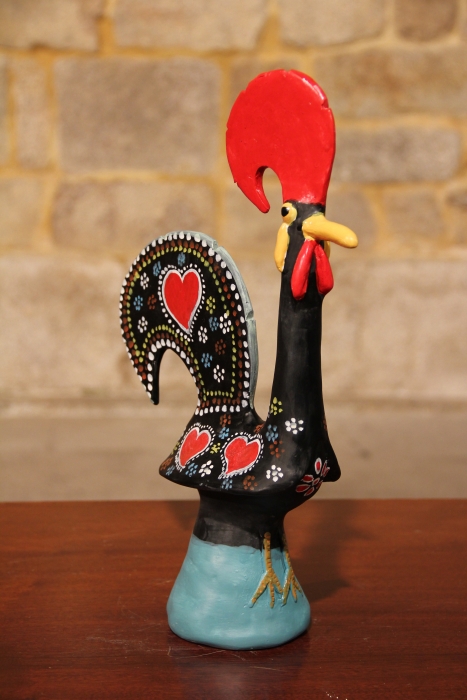
Perhaps the most widely-travelled of the figurines from Barcelos is the colourful cockerel, which has become one the symbols of Portugal. No self-respecting souvenir shop would be without a Barcelos cockerel, whether it be a tasteful handmade version or a tacky mass-produced one.
It stems from a legend about a wrongly-condemned man who was saved from the gallows by a cockerel. While protesting his undeserved sentence the man pointed to a cooked cockerel and declared that it would crow to prove his innocence. Lo and behold, the cock crowed and the man was freed.
Portuguese azulejos
17th or 18th century scenes of a social or religious nature.
Go to any city and you’ll spot colourful homes clad in geometrically patterned tiles. Both types of decorative tiles are known as azulejos. Porto, in particular, has some splendid examples of azulejo-clad churches and chapels and some outstanding pictorial panels in São Bento train station.
Essentially, you’ll find countless examples of Portuguese pottery wherever you go, both indoors and outside.


